Every year, global organizations spend over $400 billion on employee training. Every year, most L&D teams struggle to justify that spend to their CFO.
The problem isn't that learning doesn't work. The problem is that most L&D teams measure the wrong things — and what they do measure, the board doesn't care about.
The Happy Sheet Trap
The Kirkpatrick model has existed since 1959. Four levels: Reaction, Learning, Behavior, Results. Most L&D teams measure Level 1. A few measure Level 2. Almost none measure Level 3 or 4.
Level 1 (Reaction) is the post-training survey. "Did you enjoy the course?" "Was the facilitator engaging?" These are satisfaction scores — the hotel checkout card of learning. They measure whether people were comfortable, not whether they were changed.
Callout: Your board doesn't care about completion rates. They care about whether revenue went up, errors went down, or talent stayed longer. Happy sheets don't answer any of those questions.
Research from the Association for Talent Development shows that 91% of organizations measure L1, 54% measure L2, 23% measure L3, and just 8% measure L4. That gap between 91% and 8% is where most L&D budgets go to die.
Kirkpatrick L1-L4: What Each Level Actually Measures
Level 1: Reaction
Reaction data is fast and cheap to collect, which is why everyone collects it. Its real value is narrow: it tells you whether learners found the experience engaging enough to complete it, and flags obvious delivery failures. A 3.2/5 rating on a facilitated workshop might mean the facilitator was weak, the room was too cold, or the content was irrelevant to the audience.
What reaction data cannot tell you: whether anyone learned anything, whether behavior will change, whether performance will improve.
Use L1 data to iterate on design and delivery. Don't use it to justify budget.
Level 2: Learning
Learning measurement captures knowledge acquisition and skill demonstration. Pre/post assessments, simulations, role-plays, scenario-based tests — these measure whether participants left the training with capabilities they didn't enter with.
Strong L2 design separates knowledge recall (did they absorb it?) from skill application (can they do it?). A sales rep who scores 90% on a product knowledge test may still struggle on a live objection-handling simulation. Both tests belong in an L2 measurement plan.
The learning science literature is clear on one point: L2 assessments are far more predictive of behavior change when they're spaced (tested again at 7 and 30 days) rather than immediate. A post-training quiz administered the same day measures short-term memory. A quiz administered three weeks later measures retention.
Level 3: Behavior Transfer
This is the hardest level to measure, and by far the most important.
Behavior transfer asks: did the training actually change how people work? Not whether they remembered content in a quiz, but whether their observable behavior on the job shifted.
The gap between L2 and L3 is where most training investment evaporates. The research is sobering: Brinkerhoff's Success Case Method studies consistently show that only 15–20% of learners transfer training to job behavior without deliberate post-training support. That means 80% of your training budget produces behavior change in less than a fifth of your learners.
Three proven mechanisms that improve transfer:
- Manager reinforcement: Research from the Transfer of Training literature shows that manager behavior accounts for more variance in transfer than the quality of the training itself. A manager who references training content in weekly 1:1s dramatically increases transfer rates.
- Spaced practice: One-time events don't build habits. Micro-learning nudges delivered in the workflow — not in a classroom — make behavior change sustainable.
- Accountability structures: Learners who commit to specific on-the-job actions during training (implementation intentions) are significantly more likely to act on them.
Measuring L3 requires behavioral data. 360-degree feedback, observed performance reviews, manager assessments, call recording analysis, customer satisfaction scores by rep — the mechanism depends on the skill domain.
Level 4: Results
Level 4 links training to business outcomes. Revenue per employee. Error rate reduction. Time-to-hire improvement. Customer retention. These are lagging indicators — they take time to materialize — but they're the language the CFO speaks.
The challenge at L4 is attribution. Training is never the only variable. A sales team that improves close rates by 12% after communication skills training also had a new CRM, a product update, and a stronger macro environment. Isolating training's contribution requires control groups, pre/post tracking, and some methodological humility.
The Phillips ROI Methodology — a fifth level added to Kirkpatrick by Jack Phillips — formalizes this into an actual ROI formula: (benefits - costs) / costs × 100. Most L&D teams don't have the data infrastructure to run this calculation rigorously, but the exercise of attempting it forces them to define what "business outcome" they're actually targeting before training begins.
The 30-Day ROI Audit Checklist
Before your next budget review, run this audit across your current training portfolio:
For each program in your catalog:
- Is there a defined business outcome this training is meant to move? (If not, question its existence.)
- Is there pre/post assessment data, not just completion rates?
- Have learners been surveyed 30 days post-training on behavior application?
- Has the manager population been briefed on their role in reinforcing transfer?
- Is there a control group or comparable cohort for impact isolation?
- Are L4 metrics being tracked for the 6 months following training?
- Can you produce a 1-slide business case for this program in 10 minutes?
If you can check fewer than four of these for your flagship programs, your L&D function is measuring activity, not impact.
Callout: The ROI audit isn't a one-time project. It's a design standard. Every new program that enters your catalog should answer these questions before it gets a budget line — not after.
Why L3 Is the Battle Worth Fighting
Management training programs, leadership development investments, communication workshops — these initiatives live or die at Level 3. The content in most corporate training is adequate. The delivery is frequently competent. The design often reflects current instructional best practices.
What kills impact is the organizational context those learners return to after training.
If a new manager attends a feedback skills workshop but works for a director who never gives feedback, the training evaporates within weeks. The signal from the environment is stronger than the signal from the classroom. L3 measurement makes this visible. Without it, L&D takes the blame for a culture problem.
The most strategically important thing an L&D team can do in 2026 is shift the conversation from "training delivery" to "capability transfer" — and L3 measurement is the evidence that shifts it.
What Modern L4 Looks Like
Two practical examples worth benchmarking:
Google's Project Oxygen (internal management research): Google identified eight behaviors that predict manager effectiveness, trained managers on those behaviors, measured manager quality scores quarterly, and tracked the correlation with team performance metrics. They could demonstrate, with confidence intervals, which management behaviors drove retention and which drove productivity.
Walmart's VR safety training: After deploying VR-based safety simulations, Walmart tracked incident rates before and after across stores. The L4 data showed a measurable reduction in workplace injuries — a concrete dollar figure that justified further VR investment.
Neither of these required exotic research methodology. They required defining the outcome metric before training began, and building a measurement plan around it.
Callout: The single highest-leverage change most L&D teams can make is requiring a "business outcome hypothesis" before any new program is approved. What metric will move? By how much? By when?
Where Omie Fits
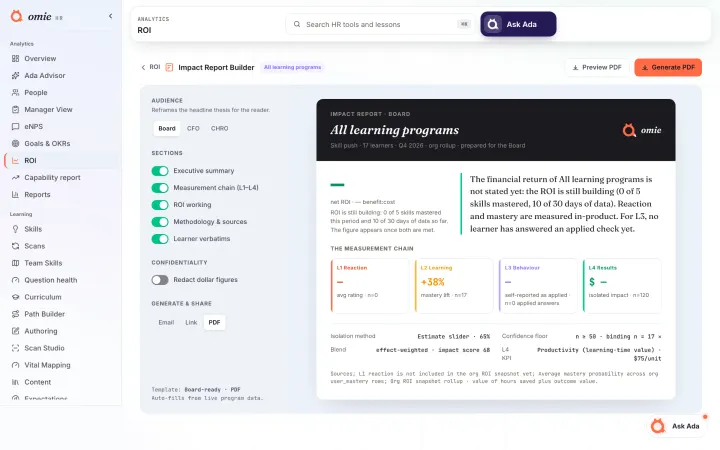
Omie's Kirkpatrick rollup is built into the Business tier. Every learning sprint produces L1 (completion + reaction), L2 (spaced knowledge checks), and L3 signals (behavior change self-report and manager confirmation at 30 days). L4 dashboards connect learning activity to the performance metrics your team already tracks.
The Manager Dashboard surfaces transfer gaps in real time — you see which learners applied skills on the job and which are stalling. That's not a report you generate quarterly. It's a live signal.
L&D teams that speak the language of business outcomes don't get their budgets cut. They get expanded.
Start measuring at all four levels. Run a skills scan to identify where your biggest transfer gaps are, and build your next ROI audit from there.